Albert Camus
Albert Camus was a French Algerian author, philosopher, and journalist who was awarded the Nobel Prize for Literature in 1957. He was a key philosopher of the 20th-century and his most famous work is the novel *L'Étranger* (*The Stranger*).
In 1949, Camus founded the Group for International Liaisons within the Revolutionary Union Movement, which was a group opposed to some tendencies of the surrealistic movement of André Breton. Camus was the second-youngest recipient of the Nobel Prize for Literature - after Rudyard Kipling - when he became the first African-born writer to receive the award. He is the shortest-lived of any literature laureate to date, having died in an automobile accident just over two years after receiving the award.
He is often cited as a proponent of existentialism, the philosophy that he was associated with during his own lifetime, but Camus himself rejected this particular label. In an interview in 1945, Camus rejected any ideological associations: "No, I am not an existentialist. Sartre and I are always surprised to see our names linked…"
Books
- L’étranger 1998
- La Peste 1948
- La Chute 1963
- Le mythe de Sisyphe 2000
- The Myth of Sisyphus and Other Essays 1959
- L'Homme révolté 1969
- La Mort heureuse 1971
- L'exil et le royaume 1997
- Perrine's literature, Structure, sound and sense--Eighth edition
- Perrine's Literature--Structure, Sound & Sense--Twelfth Edition
- Le premier homme 2001
- Literature--An Introduction to Fiction, Poetry, Drama and Writing--Eleventh Edition
- Caligula 1981
- Prentice Hall Literature--World Masterpieces
- Great Short Stories of the World
- Plays (Caligula / Malentendu / L'État de Siège / Justes) 1984
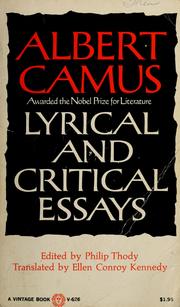
- Lyrical and critical 1967
- Essais 1965
- Correspondance 1944-1959
- Carnets. mai 1935 — fevrier 1942 1963
- Carnets 1998
- Les Possédés 1959
- Lo Straniero
- The Story and Its Writer -- Ninth Edition