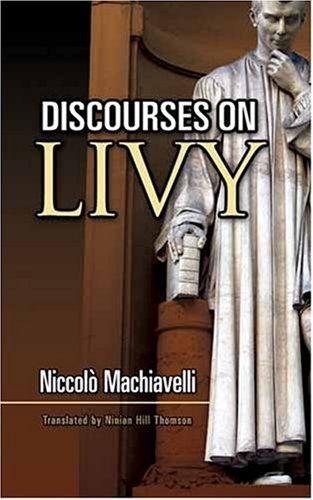
Discourses on Livy
About this book
A very different work from his well-known The Prince, and posthumously published a year prior to it, Machiavelli’s Discourses on Livy is one of his most debated works. Some critics see it as presenting a counterpoint or refutation of The Prince, calling it a key founding document of modern liberal republicanism. Others maintain that it is complementary, arguing that leaders of republics must act in the manner Machiavelli prescribes in The Prince if they are to maintain their state’s freedom. In any case, it is a deep and complex work of political philosophy.
Both complementary and critical of contemporary Italian Renaissance politics, culture, and religion, Discourses on Livy uses Roman history, as described in the first ten books of Livy’s Ab urbe condita, to explain Machiavelli’s views across a broad range of subjects. The 142 discourses discuss political violence, military strategy, political corruption and reform, conspiracy, public opinion, the role of religion in public life, and much more.
Subjects
- 320.9/37
- ab urbe condita (livy)
- ancient
- early works to 1700
- early works to 1800
- historiography
- history
- jc143 .m163 1970
- lectures and lecturing
- livy
- livy.00
- livy. ab urbe condita
- long now manual for civilization
- military art and science
- philosophy
- political ethics
- political science
- political science -- early works to 1800
- political science, early works to 1800
- political science--early works to 1800
- political science, philosophy
- politics and government
- rome -- historiography
- rome, historiography
- social sciences